A Bachelor of Arts (BA) in Economics is a three-year undergraduate degree that focuses on economic theory, market dynamics, statistics, and policy analysis. The program is ideal for individuals interested in finance, banking, business analysis, public policy, data interpretation, and economic research. It helps students develop strong analytical, quantitative, and decision-making skills essential for careers in both the public and private sectors.
What is BA in Economics Distance Education Course?
A BA in Economics (Distance Education) is a flexible undergraduate program that allows students to earn a Bachelor of Arts degree in Economics without attending regular on-campus classes. Designed for working professionals, homemakers, and learners unable to pursue full-time education, the program focuses on microeconomics, macroeconomics, statistics, economic policy, and applied economics and is delivered through online and correspondence learning modes.
Distance Education BA in EconomicsCourse Overview
Feature
Details
Course Name
Bachelor of Arts (BA) in Economics
Course Level
Undergraduate
Program Duration
3 Years (Divided into 6 Semesters)
Eligibility
Candidates must have completed 10+2 (Any Stream) from a recognized board
Study Materials
Available (Printed & Digital Study Materials)
Assessment
Assignments, Projects, Case Studies, and Examinations
Accreditation / Approvals
UGC-DEB Approved, NAAC Recommended
Flexibility
Ideal for working professionals, students, homemakers, and distance learners
Career Opportunities
Economist, Financial Analyst, Banking Executive, Policy Analyst, Research Assistant, Government Services
Placement Support / Assistance
Up to 100% Placement Support and Career Assistance
A BA distance education course is a versatile program designed to provide quality education in arts and humanities through distance learning. Students can choose from a range of specializations and benefit from an affordable and accessible learning model.
Eligibility Criteria and Duration for BA in Economics (Distance Learning)
Candidates interested in pursuing a BA in Economics through Distance Education must meet the following eligibility requirements and duration guidelines.
Eligibility Criteria
To enroll in a BA Economics Distance Education program, candidates must have completed 10+2 (Higher Secondary) from a recognized board in any stream. Most universities accept students with all passing marks, while some institutions may require a minimum of 45–50% aggregate. There is generally no upper age limit, making the program suitable for fresh students, working professionals, homemakers, and learners returning to education after a gap.
Duration
The BA in Economics Distance Learning program typically has a duration of 3 years, divided into 6 semesters. Many universities offer an extended completion period of 5 to 6 years, allowing students to progress at a comfortable pace. This flexibility supports learners who are balancing work, family responsibilities, or other commitments alongside their studies.
Advantages of BA in Economics (Distance Education)
1. Flexibility in Learning
A BA in Economics through Distance Education allows students to study at their own pace, making it easier to balance academics with work, family, or personal responsibilities. Learners can manage their study schedule while building strong economic and analytical skills.
2. Cost-Effective Education
Compared to traditional on-campus programs, a Distance BA in Economics is more affordable. Lower tuition fees, minimal travel expenses, and no accommodation costs make it an economical choice for quality education.
3. Easy Accessibility
Students can access digital study materials, recorded lectures, economic data resources, and assignments from anywhere. This removes geographical barriers and enables learning from reputed institutions without relocation.
4. Focused Economics Specialization
The program provides in-depth knowledge of microeconomics, macroeconomics, statistics, public finance, and economic policy. This helps students develop strong problem-solving, data analysis, and decision-making skills.
5. Career Advancement Opportunities
A BA in Economics (Distance Mode) enables working professionals to upgrade their qualifications while continuing their jobs. The degree supports careers in banking, finance, data analysis, research, policy planning, teaching, and government services.
6. Lifelong Learning Opportunity
Distance education is open to learners of all age groups. The flexible duration supports individuals returning to studies after a break, encouraging lifelong learning, intellectual growth, and professional development.
Who Should Enroll?
Candidate looking for Working professional
Candidate looking for Time Constraints
Candidate looking for Growth
Candidate looking to scale up salary
Admission Process
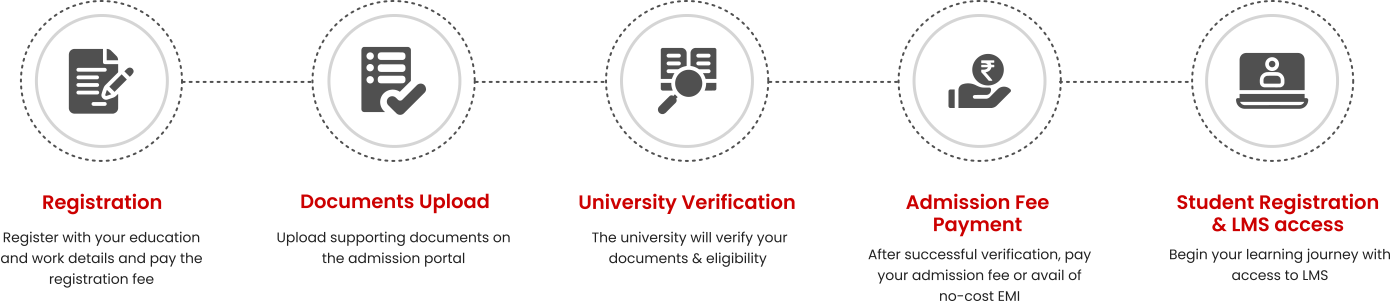
Applying for our online degrees has never been easier - follow these steps!